Jared Earl Hazleton
A Life of Curiosity and Service
September 12, 1937 — September 3, 2026
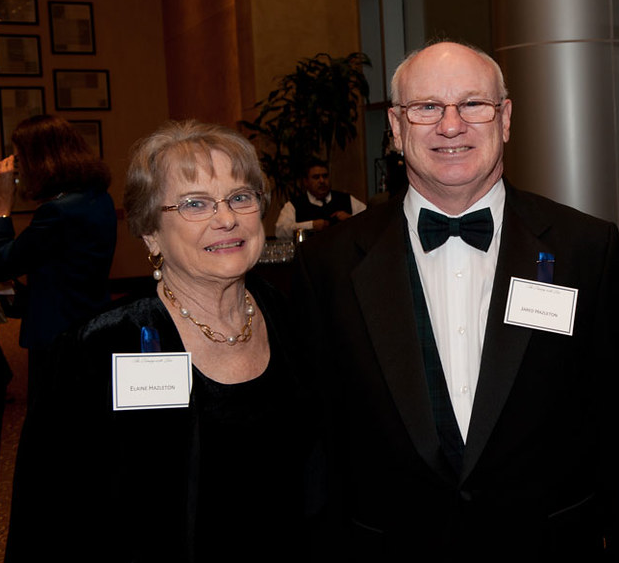
Jared Earl Hazleton was an economist, educator, Navy veteran, university dean, and public servant. He built a career in economic research, higher education, public policy, and business, while sharing sixty-six years of marriage with Elaine Hazleton.
Oklahoma roots
Jared was born on September 12, 1937, in Oklahoma City, to Alfred Larson Hazleton and Myrtle Hazleton. His sister was Susan Hazleton Swingen. The family photograph collection identifies his mother more fully as Myrtle Frances Smith Hazleton and preserves the Smith and Goode families who were part of her background.
The album gives those early years a human scale: Jared and Susan as children, cousins together in the 1940s, and several generations gathered for Thanksgiving. Captions describe the Smith family's cleaning businesses and relatives helping one another establish a shop. These are family recollections preserved alongside the photographs, offering glimpses of the people and everyday work behind the names.
Some earlier family relationships and dates are still being researched. The photographs are retained as family testimony, with uncertain identifications kept distinct from established biographical details. Jared's story begins within that network of parents, a sister, grandparents, and cousins in Oklahoma.
Sources: Family obituary — Jared Earl Hazleton · Smith family photograph collection
Elaine, Oklahoma, and the beginning of a shared life
At the University of Oklahoma, Jared studied business and graduated with a Bachelor of Business Administration in 1959. His studies included accounting. Family accounts describe an active college life that included ROTC, Beta Theta Pi, Beta Gamma Sigma, and service as vice president of the Student Senate.
OU was also where Jared met Elaine. They would share sixty-six years of marriage, raising Frances, known to the family as Franci, Alan, and Mark. Their five grandchildren were Weston, Kendall, Marlis, Berit, and Ian. Through graduate study, changing jobs, and moves across the country and overseas, their partnership remained at the center of family life.
Mark's remembrance begins by thanking his mother. The journeys and places he remembers from childhood belonged to the life both parents built. That perspective is essential to understanding Jared: the professional appointments were also chapters in a shared family story.
Sources: Family obituary — Jared Earl Hazleton · UNT InHouse — March 1999, page 3 · Hazleton family memories
From the Boston Federal Reserve to Austin
During the 1960s, Jared worked at the Federal Reserve Bank of Boston, holding research and banking-service responsibilities. His work there included fisheries economics, a subject that brought together regional livelihoods, natural resources, and industry. With Frederick W. Bell, he co-edited Recent Developments and Research in Fisheries Economics, published in 1967.
He joined the University of Texas at Austin in 1968. His career at UT included economics teaching and research, faculty service at the Lyndon B. Johnson School of Public Affairs, and administrative responsibilities as an associate dean. His research expanded into environmental policy and land-use decisions, where economic analysis could help evaluate competing public goals.
Austin also opened a world of conversation to his children. Mark remembers faculty gatherings in local parks and meeting Barbara Jordan, Walt Rostow, and Elizabeth Rostow through his father. The chance to listen and ask questions helped turn an academic environment into a lasting family enthusiasm for history and learning.
Sources: UT/LBJ coastal-zone research report — 1973 · UNT InHouse — March 1999, page 3 · Hazleton family memories
Jordan and an education in the wider world
From 1973 to 1975, Jared took leave from UT for a Ford Foundation assignment with the Royal Scientific Society in Amman, Jordan. As an economic research specialist, he worked on development questions. His scholarship included the East Ghor Canal project and the relationship between irrigation, land tenure, and land reform.
For Mark, who remembers living in Amman in second grade, this was also the beginning of an education through travel. Jared introduced him to Greece. Other family adventures included driving from Texas through Mexico to Acapulco for Christmas and camping during summers on land outside Nederland, Colorado.
The journeys mattered as much as the destinations. Mark remembers the drives and the stories retold for decades afterward. In his tribute, he describes the lesson he carried from his father: the world itself could be an education, and exploring it was something he wanted to pass on to his own children.
Sources: UNT InHouse — March 1999, page 3 · Hazleton family memories
Washington, the Texas Research League, and Mesa
Jared's next academic leadership role was dean of the University of Washington's Graduate School of Public Affairs. The family moved from Austin to Seattle in a caravan that included a boat, a truck and camper, a dog, and a cat. They traveled through national parks, sometimes reaching camp after dark and discovering the mountains around them the next morning.
After Washington, Jared returned to Austin as president of the Texas Research League. The League studied state and local government, including taxation and education finance. During a period of change in the Texas economy, he helped explain how public decisions and shifts in the energy industry affected communities. An April 2, 1986 television interview preserved by Abilene Christian University offers an opportunity to hear him discuss his work in his own voice.
He subsequently became vice president for economics at Amarillo-based Mesa Limited Partnership. The move into the energy industry connected with a longstanding interest in natural resources and the economic decisions surrounding them. Across university administration, policy research, and business, he continued to bring economic analysis to practical problems.
Sources: UNT InHouse — March 1999, page 3 · Watch: Interview with Dr. Jared Hazleton — April 2, 1986 · Hazleton family memories
Texas A&M and the University of North Texas
At Texas A&M, Jared became director of the Center for Business and Economic Analysis in 1989 and professor of finance in 1992. His work included Cost Effectiveness of Alternative Year Schooling, a 1992 study examining the practical consequences of changing school calendars. The project considered costs and educational outcomes alongside effects on families, staff, and communities.
His appointment as dean of UNT's College of Business Administration began June 1, 1999. His experience in government, business, and academia informed his interest in strengthening the college's connections with the North Texas economy.
UNT's account of his deanship records four new outreach centers, a Distinguished Executive Lecture, and a student-managed investment fund. He stepped down after the May 8, 2004 commencement and returned to teaching. His continuing faculty work forms a separate chapter from his five years as dean: leaving administration did not mean leaving education.
Sources: UNT InHouse — March 1999, page 3 · Cost Effectiveness of Alternative Year Schooling — 1992 · InHouse@UNT — May 2004, page 1
Scholarship, public service, and TexEcon
Jared's scholarship ranged from sulphur and fisheries to land reform, education, and presidential decision-making. With James E. Anderson, he wrote Managing Macroeconomic Policy: The Johnson Presidency, published in 1986. The book examined the management of economic policy within the presidency, including coordination among advisers and institutions.
His later contribution on the economy to The Impact of Global Warming on Texas continued his interest in the relationship between environmental change and economic life. The subjects varied, but the recurring questions concerned the choices people and institutions made, the resources available to them, and the consequences of those choices.
Through TexEcon, his consulting firm and website, Jared continued applying his experience to economic analysis and public understanding of the Texas economy. Teaching, research, and consulting extended his work beyond university administration. His public and professional service also included the Southwestern Economics Association, the Arthritis Foundation, and United Way.
The TexEcon archive preserves another part of his legacy: a continuing record of economic interests and analysis that can be read alongside his books, reports, and institutional work.
Sources: Managing Macroeconomic Policy: The Johnson Presidency · The Impact of Global Warming on Texas · Family obituary — Jared Earl Hazleton
Music, conversation, and showing up
The family's memories give Jared a soundtrack. On car trips he sang fraternity songs and Tom Lehrer, and his music collection included the Mills Brothers, the Kingston Trio, Willie Nelson, and Jerry Jeff Walker. At home, he played the piano while everyone prepared to go out. When he reached the boogie-woogie, Mark recalls, it was time to leave.
He wanted to know what his grandchildren thought. Marlis remembers spirited political discussions and a grandfather who took her answer seriously when he asked where she wanted to travel. She said Greece, and the family went to Athens. She also remembers something quieter: eating lunch with her grandparents almost every day during her junior year at the Conservatory.
Ian remembers a grandfather interested in his rugby, clubs, and political views, even when they disagreed. During the pandemic in 2020, Jared drove him to Rapid City for a college visit. The time together, including oysters at a rooftop bar, became a memory of being listened to and believed in.
Berit's memories include chess lessons, terrible jokes, and a 2019 cruise with Jared, Elaine, and Aunt Franci. Their last conversation brought together his pride in Berit's theatre work and his hope that the Rangers would make the playoffs.
Lesley remembers a father-in-law who worked to understand her and supported the family's decisions. He visited every home she and Mark lived in, including their home in Łódź, Poland. Her recollection captures how he often expressed affection: he showed up, took an interest, and gave each person support suited to who they were.
Sources: Hazleton family memories
A legacy carried forward
Jared died on September 3, 2026, at the age of 88, surrounded by family. His life is remembered through the partnership he shared with Elaine, their children and grandchildren, his sister and extended family, and the students, colleagues, and friends who knew him.
Shortly before his death, he urged Mark and Lesley to continue with their planned trip to Portugal. When friends there helped them raise a glass to Jared, continuing the journey became a way of honoring him. Mark connected that toast with an earlier family story: Jared and Wade Clifton sharing a bottle of Balvenie in memory of their friend George Douglas.
The memories return to a few enduring gifts: curiosity, the confidence to hold an opinion and explain it, the willingness to go somewhere unfamiliar, and the feeling of being supported. Mark's farewell promises to keep exploring and to pass that impulse to the next generation. It ends with words that belong to the life Jared helped his family discover: Safe travels.
Sources: Family obituary — Jared Earl Hazleton · Hazleton family memories
Sources & further reading
This biography brings together institutional records, published scholarship, and family recollections. The exact year of Jared’s Rice doctorate is omitted because the available accounts disagree. Earlier ancestral relationships remain under review.
- Family obituary — Jared Earl Hazleton
Family relationships, education, service, and remembrance.
- Smith family photograph collection
Family-provided photographs and captions preserved by the Hazleton family. Captions are family testimony; uncertain ancestral links are not presented here as proven.
- Hazleton family memories
Recollections by Mark, Lesley, Marlis, Ian, and Berit, together with Mark's remarks prepared for the September 19, 2026 Celebration of Life.
- UNT InHouse — March 1999, page 3
Appointment announcement and prior roles, including Jordan, Texas A&M, and university leadership.
- InHouse@UNT — May 2004, page 1
Deanship accomplishments and return to teaching after May 8, 2004.
- UT/LBJ coastal-zone research report — 1973
Contemporary public-affairs faculty and environmental research record. The family research collection supplies the broader Boston and Austin chronology.
- The Economics of the Sulphur Industry
Jared E. Hazleton's 1970 study, subsequently reissued by Routledge.
- Watch: Interview with Dr. Jared Hazleton — April 2, 1986
Archived by Abilene Christian University Library and hosted by The Portal to Texas History.
- Cost Effectiveness of Alternative Year Schooling — 1992
Texas A&M research report preserved by ERIC (PDF).
- Managing Macroeconomic Policy: The Johnson Presidency
James E. Anderson and Jared E. Hazleton, University of Texas Press, 1986.
- The Impact of Global Warming on Texas
University of Texas Press volume with Jared Hazleton's chapter on the economy.
Updated
Return to the tribute for family memories, photographs, and Celebration of Life information